Retail is entering a once-in-a-generation transformation. After years of manual operations, unpredictable foot traffic, rising labor costs, and shrinking margins, the industry is finally embracing automation at scale. At the center of this shift is computer vision in retail—a technology enabling stores to see, understand, and act on real-time events as humans do.
From frictionless checkout to predictive inventory management, computer vision is not just an innovation—it’s becoming a competitive necessity. Retailers ignoring it today risk falling behind the customer expectations of 2025.
This article breaks down how computer vision is redefining retail, the top use cases, ROI impact, deployment best practices, and what the future holds.
1. Why Computer Vision in Retail Is Becoming Non-Negotiable
Retailers are under pressure:
Customer expectations for seamless shopping
Rising operational costs
Shrinkage due to theft
Inventory inaccuracy costing billions yearly
Labor shortages
Omnichannel complexity
Computer vision solves these challenges by turning store cameras into AI-powered insights engines, enabling instant decisions without human involvement.
By 2028, 71% of global retailers are expected to adopt AI-led computer vision systems for store automation.
2. What Is Computer Vision in Retail? (Simple Explanation)
Computer vision uses AI models to see and interpret live store activity such as:
Which shelves are empty
Who picked up what item
When theft risk occurs
Where customers move
How long queues are
Which products shoppers interact with
It works using:
Cameras & sensors
Object detection models
Activity recognition
Pose detection
Edge or cloud processing
Real-time analytics
The goal: make stores autonomous, efficient, and intelligent.
3. 6 Most Transformative Use Cases of Computer Vision in Retail
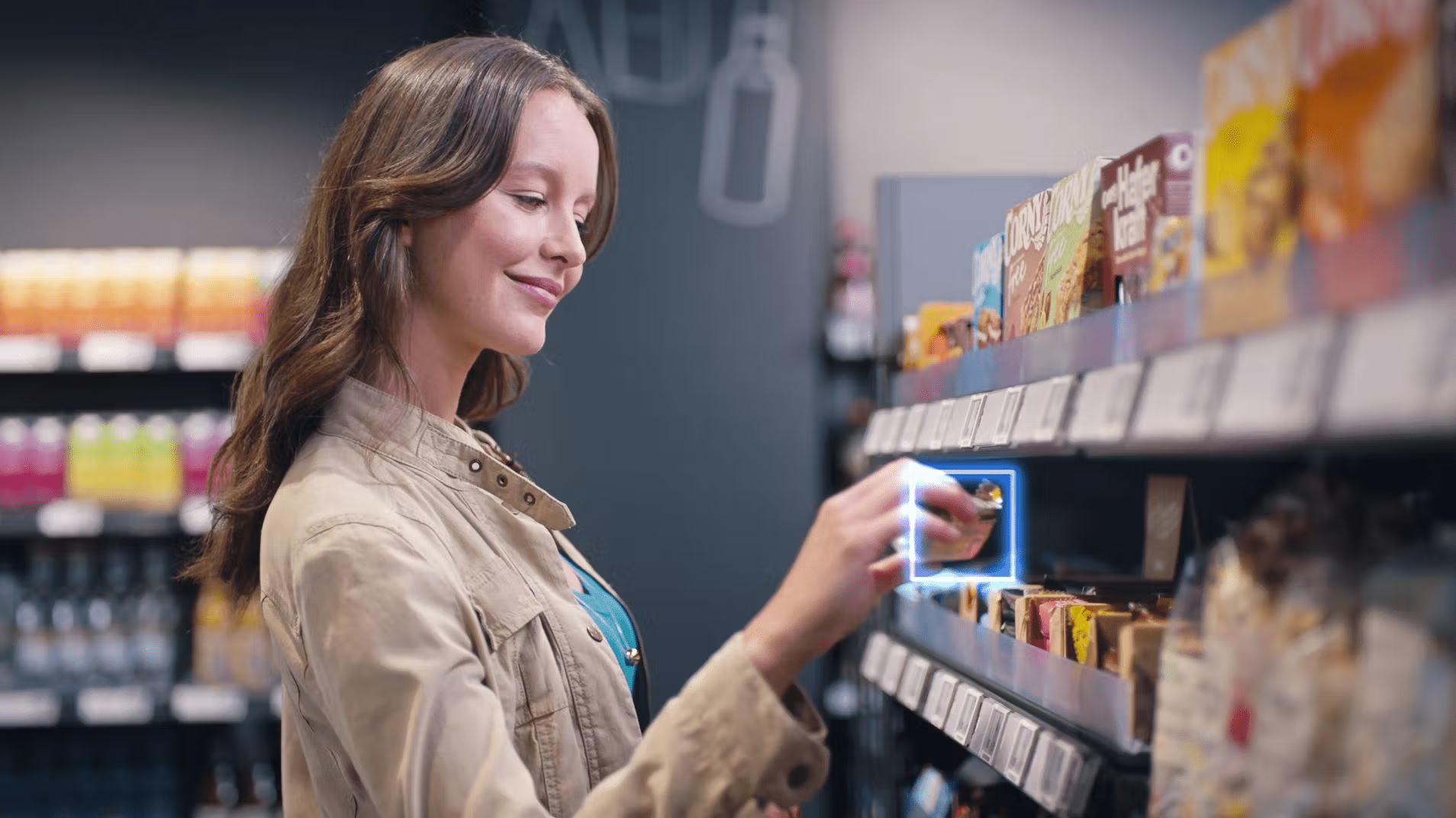
3.1 Frictionless Checkout & Smart Shopping Journeys
The future of billing is no checkout counters.
Computer vision enables:
Scanless “walk-out” checkout
Smart carts detecting every product
Automated billing via mobile
Queue-free experience
Retailers adopting frictionless checkout see:
20–40% faster store throughput
15% higher customer satisfaction
Reduced cart abandonment
Amazon Go is the best-known example, but brands like Tesco, 7-Eleven, and Carrefour are rapidly catching up.
3.2 Autonomous Inventory Management & Shelf Analytics
Manual shelf scanning is slow, expensive, and inaccurate.
Computer vision automates:
Real-time detection of out-of-stock items
Shelf compliance & planogram accuracy
Expiry tracking
Inventory forecasting
Automatic replenishment alerts
Retailers using AI inventory analytics reduce stockouts by up to 30% and improve revenue by 3–8%.
3.3 Intelligent Store Operations with Real-Time Insights
Computer vision provides operational intelligence that was previously impossible:
Heatmaps showing customer movement
Optimized store layout
Staff task allocation based on foot traffic
Queue management
Smart cleaning notifications
This leads to:
Faster service
Smoother store flow
Better staffing decisions
Improved customer experience
It’s like having a real-time command center for your store.
3.4 Advanced Loss Prevention & Security Reinvented
Traditional CCTV catches theft after it happens.
Computer vision stops it in real-time.
Capabilities include:
Suspicious behavior detection
Shelf-sweep alerts
Employee theft monitoring
Fraud prevention at checkout
Real-time shrinkage alerts
Retailers save millions by reducing losses—shrinkage falls by 35–50% after AI-based systems are introduced.
3.5 Virtual Try-On & AR-Powered In-Store Experiences
Computer vision makes physical retail feel digital.
Use cases:
Virtual try-on for clothes, shoes, eyewear
AI-powered fitting rooms
AR mirrors for cosmetics
Personalized recommendations
This enhances customer confidence, reduces returns, and increases engagement.
3.6 Personalized In-Store Marketing Powered by AI
Computer vision identifies:
Customer demographics
Mood/emotion
Product browsing behavior
Dwell time
Then it triggers:
Contextual promotions
Personalized recommendations
Dynamic pricing messages
In-store screens adapting in real-time
Retailers experience:
10–25% higher basket size
Increased cross-selling
Better brand engagement
4. How Computer Vision Works Behind the Scenes (Simple + Technical)
To make stores “sense and act,” the following components work together:
✔ Object Detection
Identifying products, people, carts, and actions.
✔ Activity Recognition
Understanding behaviors—picking, placing, returning, concealing items.
✔ Pose Estimation
Analysing body posture to predict theft or help store layout decisions.
✔ Heatmap Generation
Mapping foot traffic and engagement.
✔ Edge Computation
Process video streams on-site for speed and privacy.
✔ Cloud Processing
Used for large-scale analysis and model training.
This ecosystem enables real-time store intelligence at scale.
5. Business Benefits of Computer Vision for Retailers
Retailers adopt computer vision because the ROI is immediate and measurable.
✔ Cost Reduction
Lower labor cost
Reduced manual scanning
Lower shrinkage
Optimized store staffing
✔ Increased Revenue
Higher product availability
Personalized offers
Better store layouts
✔ Better Operational Efficiency
Automated shelf management
Faster checkout
Accurate demand forecasting
✔ Improved Customer Experience
No waiting in lines
Personalized shopping journeys
AR/VR try-on
✔ Strategic Retail Advantage
Competitive differentiation
AI-driven decision-making
6. Real-World Success Stories (2024–2025)
Walmart
Uses AI to detect spills, monitor stockouts, and automate shelf replenishment.
Sephora
Virtual try-on using computer vision increased customer engagement by 30%.
Carrefour
AI cameras reduced shrinkage by nearly 40%.
Decathlon
AI-based analytics improved shelf compliance and boosted sales.
These results prove that computer vision isn’t experimental—it’s retail’s biggest growth lever.
7. Challenges & Ethical Considerations (Balanced & Trust-Building)
Retailers must implement computer vision responsibly.
✔ Privacy & Surveillance Concerns
Follow GDPR, CCPA, and local compliance.
✔ Facial Recognition Risks
Many retailers avoid identity-based tracking.
✔ AI Bias
Models must be tested for fairness and accuracy.
✔ Data Security
Encrypted storage + anonymized streaming is essential.
Responsible AI builds customer trust and avoids legal risks.
8. How Retailers Can Implement Computer Vision Successfully
A practical adoption roadmap:
1. Define clear business objectives
Shrinkage reduction? Inventory automation? Marketing?
Start with one high-ROI use case.
2. Choose the right tech stack
Edge AI, cloud, cameras, sensors, model types.
3. Integrate with existing systems
POS, ERP, CRM, store operations software.
4. Pilot → Measure → Scale
Test in one store, track KPIs, and expand.
5. Build a roadmap for 12–24 months
Prioritize use cases with the biggest ROI.
9. Future of Computer Vision in Retail: 2025–2030
The next decade will see an explosion of smart retail innovations:
AI-powered autonomous stores
Digital twins for real-time store simulation
AI agents managing store operations
Predictive behavioral analytics
Robotics + computer vision collaboration
AR glasses for shopping assistance
Retail will shift from reactive to autonomous and predictive systems.
Conclusion: Retailers Ignoring Computer Vision Will Fall Behind
Computer vision in retail is no longer optional—it’s the new competitive advantage.
Retailers using computer vision gain:
Faster operations
Better customer experiences
Lower costs
Higher revenue
Stronger brand loyalty
Stores that adopt AI today will lead the next era of smart retail. Those that delay will struggle to meet customer expectations in 2025 and beyond.




Write a comment ...